
✅ Tomato Paste Price Per Ton Wholesale Worldwide
🔥 1. Introduction: Why Tomato Paste Price Per Ton Matters Now
When importers, traders, and brand owners search for “Tomato Paste Price Per Ton”, they rarely look for theory. They need real numbers, clear specs, and reliable supply. Global demand for tomato-based products grows every year, and therefore buyers feel strong pressure to secure stable prices for the right Brix degree and the right quality. At the same time, freight rates change, crop conditions shift, and currency moves almost every day. Because of that, a smart buyer does not look at price alone; instead, they look at total cost per finished kilo of sauce or ketchup.
Today, industrial buyers in Saudi Arabia, the Gulf, Europe, Africa, Asia, and Latin America use tomato paste as a functional base for many products. They produce ketchup, pasta sauces, pizza sauces, ready-cooked tomato sauces, and food service packs for restaurants and hotels. For all these applications, they usually choose industrial grades such as 28–30° Brix, 30–32° Brix, 32–34° Brix, and 36–38° Brix. Each grade delivers a different balance between concentration, viscosity, and cost. Therefore, your choice of Brix degree directly affects the Tomato Paste Price Per Ton you accept and the profit you finally keep.
However, price per ton never comes from one factor. It depends on:
- Origin country (for example Egypt, Italy, China, Turkey, USA).
- Brix degree and processing type (hot break, cold break, or super hot break).
- Packaging format (aseptic drums, IBCs, tins, retail glass or cans).
- Shipping terms (EXW, FOB, CFR, CIF) and distance to your port.
Because of these variables, two offers with the same “Tomato Paste Price Per Ton” may create very different costs in your factory. One offer may include stronger color, higher Brix, and better yield. Another offer may include cheaper packaging or shorter shelf life. As a result, serious importers always analyze the technical data sheet and the Brix degree before they negotiate the final price.
At the same time, competition between supplying countries grows. Egypt, for example, leverages its climate, long processing season, and strategic location near Saudi Arabia, GCC, North Africa, and Southern Europe. Therefore, many buyers now consider Tomato Paste EXPORT FROM EGYPT TO WORLDWIDE markets as a strategic option. They combine competitive cost with acceptable transit time and stable quality, especially for industrial 28–30° and 36–38° Brix paste that works perfectly as a base for sauces.
⭐ Eurovan Trading Credibility & Data-Driven Approach
Eurovan Trading operates as a professional trading and export partner in the FMCG and food sector. The company focuses on long-term cooperation with importers and distributors rather than one-time deals. Because of that, Eurovan always builds its recommendations on:
- Official international trade and market information.
- Factory technical specifications for each tomato paste Brix degree.
- Practical feedback from sauce and ketchup manufacturers in different regions.
If you want to know more about Eurovan’s background, you can explore the company profile on the About Us page and review the portfolio on the Brands page.
Eurovan does not publish one fixed Tomato Paste Price Per Ton list, because serious B2B prices change with crops, seasons, and shipping conditions. Instead, the team supplies accurate, customized offers when you share your target market, preferred Brix degree, and packaging format. Whenever you need a live quotation, you can simply get a quote and receive a tailored offer for your destination.
In the next sections, you will see exactly what hides behind the number you see on a tomato paste price list, how Brix degrees like 28–30 and 36–38 affect cost, and how importers in leading markets calculate their real profitability.
Direct Contact – Eurovan Trading (Tomato Paste Price Per Ton from Egypt)
- Mobile: 00201208287576
- WhatsApp: 00201208287576
- Email: [email protected]
- Website: www.eurovantrading.com
💡 2. What Does Tomato Paste Price Per Ton Actually Include?
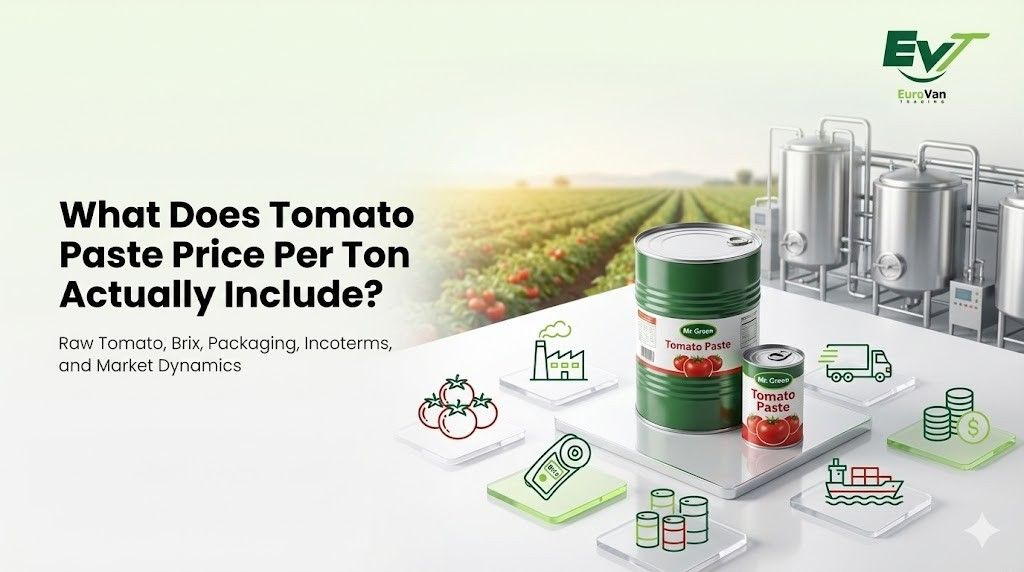
Many buyers focus first on the headline Tomato Paste Price Per Ton and only later discover hidden cost drivers. To negotiate confidently, you need to understand every component that shapes this figure. When you break the price into parts, you gain stronger control over margin, quality, and long-term supply.
2.1 Raw Tomato and Processing Costs
First, processors buy fresh tomatoes. The farm gate price, the yield per ton of fresh tomato, and the quality of raw material all influence the final cost. Factories that receive high-quality tomatoes with high natural Brix need fewer tons of fresh fruit to produce one ton of concentrated paste. Therefore, these factories often control their processing cost more effectively.
Secondly, the processing method also matters. Producers use hot break (HB or SHB) when they want strong viscosity and a thicker mouthfeel. They use cold break (CB) when they want brighter color and fresher tomato notes. Hot break generally requires more energy because processors heat tomatoes quickly to deactivate enzymes. Consequently, energy prices and processing efficiency impact the final price per ton.
When raw tomato prices increase because of weather, water issues, or crop shortages, factories need to recover these costs. You will then see that Tomato Paste Price Per Ton for export jumps, even when freight or packaging stays stable. Therefore, importers always monitor news about tomato crops in key supplying regions.
2.2 Brix Level as a Core Price Driver
The Brix degree measures the concentration of soluble solids in tomato paste, mainly natural sugars and acids. A higher Brix degree indicates a more concentrated product, which contains more tomato solids per ton. To reach 36–38° Brix, a factory must evaporate more water and process more tomatoes than for 28–30° Brix. As a result, high-Brix paste naturally carries a higher price per ton than low-Brix paste from the same origin.
However, industrial buyers rarely use high-Brix paste “as is”. They dilute it with water and adjust salt, sugar, spices, and other ingredients to produce ketchup or sauces. When you calculate your cost per finished kilogram of sauce, a ton of 36–38° Brix sometimes delivers a better yield and a lower cost per unit than a lower Brix grade. Because of this, a smart importer always compares offers at the same finished product standard, not only at the paste level.
For sauces and ketchup, many manufacturers prefer 28–30° Brix or 36–38° Brix industrial paste. They choose 28–30° when they want easier handling and faster dilution. They choose 36–38° when they want maximum flexibility, stronger color, and lower storage and freight cost per liter of finished product.
2.3 Packaging and Format
Next, you need to consider the packaging format, because packaging also enters the Tomato Paste Price Per Ton calculation. For industrial export, suppliers usually offer:
- Aseptic 220 L steel drums with food-grade liners
- 1000 L IBCs or totes
- In some cases, large tins (for example 3 kg or 4.5 kg)
Aseptic drums require special liners, high-quality steel, and careful handling. Therefore, they add more cost per ton than large tins. However, they also protect the paste for a longer shelf life and allow easy pumping into processing lines. When you spread packaging cost over large industrial batches, the difference often remains acceptable.
Retail tins and glass jars, on the other hand, include more material, more printing, and more labor. Consequently, when you buy Tomato Paste Price Per Ton in retail-ready packs, you pay not only for the paste but also for branding, retail compliance, and consumer packaging.
2.4 Incoterms and Logistics
Incoterms define how far the supplier’s responsibility extends and which cost each side covers. This point often creates confusion, because buyers compare a FOB price per ton from one supplier with a CIF price per ton from another supplier. To make a fair comparison, you must always add or remove freight and insurance so that you compare equal conditions.
- Under EXW, you collect the goods from the factory gate and pay all transport.
- Under FOB, the supplier loads the goods on the vessel in the port of origin.
- Under CFR/CIF, the supplier includes ocean freight, and under CIF also includes insurance up to your port.
For example, when you import to Saudi Arabia, freight from Egypt usually remains more competitive than freight from distant origins. Therefore, an apparently higher FOB Tomato Paste Price Per Ton from Egypt may become more attractive once you add freight from other suppliers.
2.5 Market and Currency Factors
Finally, broader market conditions influence every quotation. Global supply and demand for tomato paste, competition between origin countries, and international trade measures all affect price. When crop shortages hit one major producer, buyers shift to alternative origins. Therefore, you may see higher offers even from countries with stable crops.
Currency also plays a strong role. Many contracts use USD or EUR, while local costs stay in different currencies. When the local currency of the producing country weakens, exporters sometimes gain a temporary advantage. When it strengthens, they face pressure to increase their Tomato Paste Price Per Ton to protect margin.
Because of all these moving parts, professional importers never rely on outdated price lists. Instead, they request updated offers based on current Brix degree, packaging, destination port, and Incoterms. Eurovan Trading supports this process and helps buyers read each offer correctly, so that they choose the most economical option for their sauce and ketchup lines.
🔬 3. Tomato Paste Brix Degrees & Best Grades for Sauces

When you buy tomato paste for industrial use, you are not just buying a red product in a drum. You are buying a certain concentration of tomato solids that will become the base of your ketchup, pasta sauce, pizza sauce, or ready-made tomato sauce. This is why understanding Brix degrees is essential before you decide on any Tomato Paste Price Per Ton offer.
3.1 What Is Brix and Why Does It Matter?
In simple terms, Brix is a measurement of the percentage of soluble solids in tomato paste. These solids are mostly natural sugars, organic acids, and minerals from the tomato.
- A paste at 28–30° Brix means that around 28–30% of its weight is soluble solids.
- A paste at 36–38° Brix means higher concentration, with more solids and less water.
Because higher Brix contains more tomato per ton, factories must process more fresh tomatoes and use more energy to evaporate water. Therefore, higher Brix products usually come with a higher Tomato Paste Price Per Ton, especially when quality and origin are comparable.
For sauce and ketchup manufacturers, Brix is not just a technical number. It determines:
- How much water you need to add.
- How thick your final product feels in the mouth.
- How intense the color and flavor will be.
- How efficient your production line becomes.
When you understand Brix, you can compare different offers using one logic: “How many tons of finished sauce can I produce from one ton of paste?”
3.2 Key Industrial Tomato Paste Grades (28–30, 30–32, 32–34, 36–38)
In the wholesale worldwide market, the following Brix levels are common for tomato paste used as a base for sauces:
✅ 28–30° Brix – The Standard Sauce Base
This is one of the most popular industrial grades. Many factories choose 28–30° Brix because it offers a good balance between ease of use and concentration.
- Main applications:
- Ketchup and table sauces
- Pasta sauce and pizza sauce
- Ready-made cooking sauces
- Advantages:
- Easy to dilute and standardize
- Good color and flavor for mass-market brands
- Often available in both hot break (HB/SHB) and cold break (CB)
If your factory wants simple handling and does not need maximum concentration, 28–30° Brix can be the most economical choice. It keeps the Tomato Paste Price Per Ton at a mid-level, while still giving you efficient yields.
⭐ 30–32° and 32–34° Brix – Custom Intermediate Grades
Some producers and buyers prefer 30–32° Brix or 32–34° Brix as intermediate grades. These levels are not as universally standard as 28–30° or 36–38°, but they are attractive when a buyer needs:
- Slightly higher concentration than 28–30° Brix.
- A specific viscosity and texture for a unique sauce recipe.
- Better logistics efficiency while still keeping processing simple.
These grades are often negotiated as custom products, so they may carry a small premium. Still, when used correctly, they offer an interesting compromise between price and performance.
🔥 36–38° Brix – Double Concentrated Tomato Paste
36–38° Brix is widely known as double concentrated tomato paste. Here, water content is significantly reduced, and tomato solids are much more concentrated.
- Main applications:
- High-quality ketchup with rich consistency
- Thick pizza and pasta sauces
- Industrial sauce bases for further processing
- Advantages:
- Lower shipping cost per ton of tomato solids (you ship less water).
- High flexibility: you can dilute to your desired Brix for different recipes.
- Strong color and flavor that helps differentiate premium products.
Because of the extra tomatoes and energy required, 36–38° Brix typically has a higher Tomato Paste Price Per Ton for export than 28–30° Brix. However, its cost per finished kilogram of sauce can be equal or even lower, once you do the full calculation.
Other Brix Levels (12–14, 14–16, 22–24, 24–26)
For completeness, there are also lower Brix tomato products like:
- 12–14° / 14–16° Brix: often used for crushed tomato or passata-style products.
- 22–24° / 24–26° Brix: used for tomato purée or semi-concentrated products.
These are more common in retail and food-service formats, less in pure industrial pastes for ketchup production.
3.3 Brix Degree vs Use Case vs Relative Price – Comparison Table
To help you visualize the differences, here is a simplified table. It does not show real prices, but it illustrates relative price levels between grades:
| Brix Degree | Typical Type | Main Applications | Relative Price per Ton* |
|---|---|---|---|
| 12–14 / 14–16 | Crushed / passata-style | Cooking bases, HORECA, fresh-style tomato products | Low |
| 22–24 / 24–26 | Concentrated purée | Ready meals, soups, light sauces | Low–Medium |
| 28–30 | Standard tomato paste (CB/HB) | Ketchup, pasta and pizza sauces, cooking sauces | Medium |
| 30–32 / 32–34 | Special industrial pastes | Custom sauces, private label, specific viscosity needs | Medium–High |
| 36–38 | Double concentrated paste | Premium ketchup, thick sauces, industrial formulations | High |
*“Relative price” means typical market behavior: actual values will always depend on origin, season, and specification.
3.4 How Buyers Choose the Right Brix for Their Brand
When you decide on a Brix level, you are really deciding on how your finished product will behave in the market.
Most professional buyers start from three questions:
- What is the target Brix and texture of my finished sauce or ketchup?
- What is the cost per finished kilogram or liter that I need to reach?
- How important are color, flavor intensity, and mouthfeel for my brand?
If you produce a mass-market ketchup for a price-sensitive segment, a 28–30° Brix industrial paste might be ideal. It is easy to process and usually offers a very competitive Tomato Paste Price Per Ton Wholesale Worldwide.
If you produce a premium, thick ketchup or a gourmet pizza sauce, you may choose 36–38° Brix. You will probably pay more per ton of paste, but you will enjoy higher color strength, better thickness, and strong marketing advantages.
Sometimes, the best solution is a mix. For example, you can blend a 36–38° Brix paste with a lower Brix product to fine-tune the final consistency and flavor.
💡 Eurovan Trading often helps importers from Saudi Arabia, Europe, Africa, and Latin America to compare these scenarios. By looking at your recipes and target markets, the team can suggest whether 28–30, 30–32, 32–34, or 36–38 Brix is the most strategic choice for your next shipment from Egypt.
💰 4. Indicative Tomato Paste Price Per Ton by Brix & Packaging
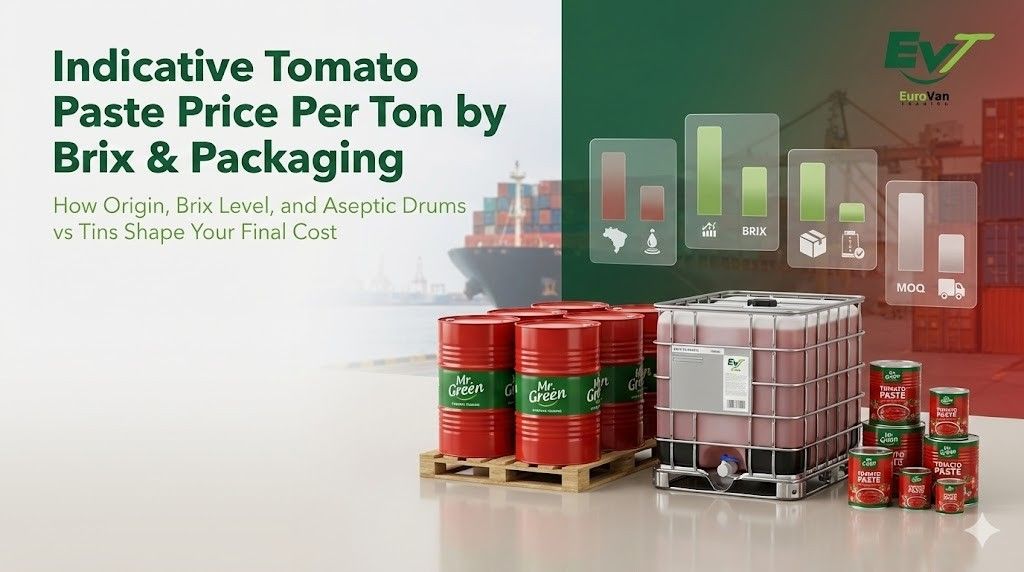
Now that you understand the role of Brix degrees, it becomes easier to read and negotiate any Tomato Paste Price Per Ton for export. In real business, suppliers rarely publish fixed global lists; instead, they work with indicative ranges and then adapt them based on your exact inquiry.
4.1 Why Exact Prices Are Always “On Request”
Tomato paste is an agricultural, seasonal product. Therefore, its wholesale price behaves more like a commodity than a finished FMCG item. Several dynamic factors push prices up or down during the year:
- Weather and crop size in major producing regions.
- Fresh tomato availability and cost.
- Energy prices in the producing country.
- Ocean freight rates and container availability.
- Exchange rates for local currency vs USD/EUR.
Because of these moving parts, a price you saw three months ago is almost never valid today. This is why serious suppliers like Eurovan Trading prefer to share live offers. When you submit your request via the Get a Quote page and mention your required Brix, packaging, quantity, and destination, you receive a quotation that reflects real market conditions, not guesswork.
4.2 How Brix Influences Tomato Paste Price Per Ton
From a cost point of view, higher Brix means:
- More fresh tomatoes are needed to make one ton of paste.
- More energy is required to evaporate water and concentrate the product.
- More processing time and sometimes more sophisticated equipment.
Therefore, in the same origin and with similar specs:
- 36–38° Brix typically costs noticeably more per ton than 28–30° Brix.
- 30–32° and 32–34° Brix usually sit between these two in terms of price.
However, price per ton is only half of the story. Imagine two simplified scenarios:
- Paste A: 28–30° Brix at a lower price per ton.
- Paste B: 36–38° Brix at a higher price per ton.
If you calculate how many tons of ketchup you produce from each ton of paste, you may discover that B, despite being more expensive per ton, gives you more finished product and therefore a lower cost per kg of ketchup. This is the real metric that matters for a manufacturer.
Because of that, professional importers ask for offers on multiple Brix levels and compare them using their own recipes. Eurovan Trading can support this analysis by providing solids content, typical dilution ratios, and practical advice from existing clients.
4.3 Impact of Origin Country on Price
Besides Brix, the origin country strongly influences the Tomato Paste Price Per Ton Wholesale Worldwide. Each origin has a unique combination of farming conditions, labor cost, energy price, and logistic position.
- Egypt
- Competitive production cost and long tomato season.
- Strategic location close to Saudi Arabia, GCC, North Africa, and Europe.
- Strong capabilities in industrial 28–30° and 36–38° Brix paste packed in aseptic drums.
- Attractive for importers who want a balance between cost and transit time.
- Italy / Spain / Portugal (EU origins)
- Generally known for high-quality tomato products and strong branding.
- Often command a premium, especially for retail and branded products.
- Suitable for buyers targeting the “European quality” positioning.
- China
- Historically one of the key global suppliers of industrial tomato paste.
- Competitive pricing, especially for large-volume contracts.
- Some markets may apply additional checks or trade conditions depending on local regulations.
- Turkey, USA, and others
- Important players that offer region-specific advantages, such as proximity to nearby markets or specific quality profiles.
Importers do not choose origin on price alone. They also consider trade policies, customs duties, consumer perception, and logistic reliability. For many markets, Tomato Paste EXPORT FROM EGYPT TO WORLDWIDE is becoming an attractive strategy, because it combines cost efficiency with geographic and cultural proximity, especially for Arab and African buyers.
4.4 Role of Packaging, MOQ, and Shipment Size
Packaging can add a surprising amount to the Tomato Paste Price Per Ton if you do not analyze it carefully.
- Aseptic drums
- The most common format for industrial exports.
- Higher packaging cost than bulk tankers, but excellent shelf life and safety.
- Ideal for shipping full container loads (FCL) to Saudi Arabia, Europe, Africa, and beyond.
- IBC / 1000 L totes
- Useful for specific logistics setups and for buyers who want different handling options.
- Retail tins and glass jars
- Much higher packaging and labor cost per ton.
- Include costs of printed packaging, labeling, and retail compliance.
Minimum order quantity (MOQ) also affects price. A full 20ft or 40ft container in aseptic drums usually gives you the most competitive price structure. Small, fragmented orders require more handling and often result in:
- Higher price per ton.
- Less favorable payment or credit terms.
By planning shipments in full container loads and aligning your forecasts with the supplier, you can often achieve a better Tomato Paste Price Per Ton for export without changing origin or Brix.
4.5 Practical Example: Thinking Beyond the Ton Price
To see why it is dangerous to focus only on the headline number, let’s build a very simple hypothetical example (numbers are for illustration only):
- Offer 1:
- 28–30° Brix tomato paste from Egypt in aseptic drums.
- Lower price per ton.
- Offer 2:
- 36–38° Brix tomato paste from Egypt in aseptic drums.
- Higher price per ton.
At first glance, Offer 1 looks cheaper. However, you need more kilograms of Offer 1 to reach the same finished sauce solids as you would get from Offer 2. After you calculate:
- How much water you will add.
- How much finished product you will obtain from each ton.
- How many tons you can fit in one container.
…you may discover that Offer 2 actually lowers your cost per finished kilogram of ketchup or sauce, especially if you run high-volume production.
This is exactly why Eurovan Trading encourages buyers to think in terms of total landed cost and cost per finished kilogram, not just Tomato Paste Price Per Ton. With the right Brix level, origin, and packaging, you do not simply buy paste; you buy profitability and stability for your sauce brand.
🌍 5. Where Is Demand Strongest? Top Import Markets for Tomato Paste
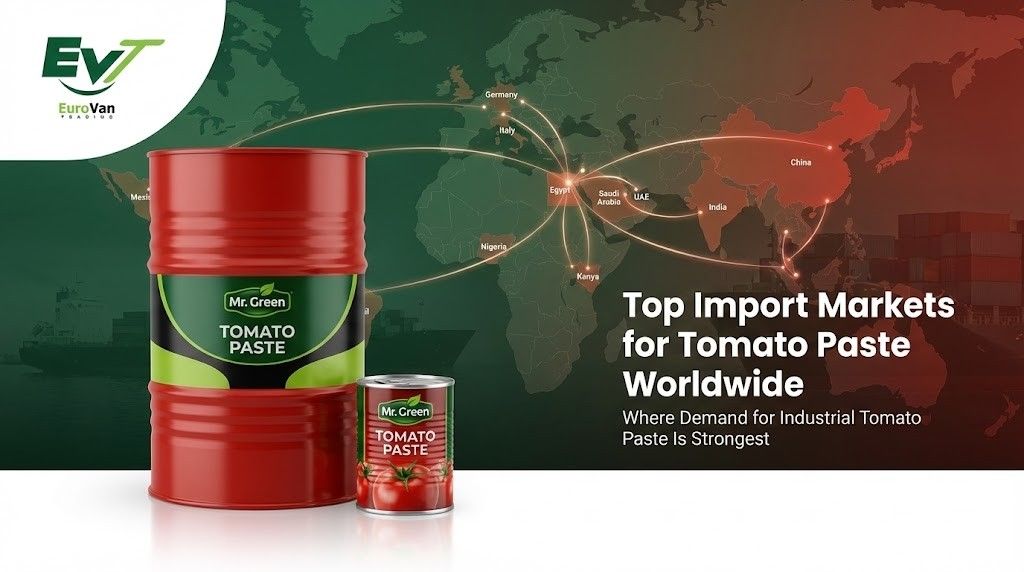
Now that you understand how Tomato Paste Price Per Ton works and how Brix degrees affect cost, it is time to look at who actually buys all this paste. When you know the main import markets, you can plan your brand, your specifications, and even your logistics more intelligently.
Global trade data shows that demand for tomato paste and other processed tomato products concentrates in a few big regions. However, many emerging markets also grow quickly and create opportunities for exporters from Egypt and other origins.
5.1 Global Demand Snapshot
Around the world, tomato-based products form a key part of everyday cooking. Because of that, demand for tomato paste remains strong even in times of economic pressure. Consumers may trade down from premium brands to value brands, but they still buy sauces, ketchup, and tomato-based ready meals. This behavior keeps import volumes relatively stable and supports continuous demand for Tomato Paste Price Per Ton Wholesale Worldwide contracts.
Large importers usually include:
- European countries such as Germany, the United Kingdom, France, Italy, the Netherlands, and Poland.
- Asian markets such as Japan, China, and some Southeast Asian countries.
- Middle Eastern and Gulf countries, especially Saudi Arabia and neighboring markets.
- African and Latin American countries, including Ghana, Nigeria, Mexico, and others.
Each group of markets buys tomato paste for different reasons. Some focus on retail products with strong brands. Others buy bulk paste and use it as an ingredient in private label or food-service solutions.
To organize this better, consider the following simplified view:
| Region | Example Importers | Main Uses | Key Needs |
|---|---|---|---|
| Middle East & Gulf | Saudi Arabia, UAE, Kuwait, Iraq | Ketchup, sauces, food service, retail | Halal, strong color, price focus |
| Europe | Germany, UK, France, Netherlands, Poland | Retail brands, private label, industry | Certifications, traceability |
| Asia | Japan, China, Thailand | Sauces, ready meals, food service | Consistency, stable supply |
| Africa | Ghana, Nigeria, others | Affordable retail, food service | Competitive CIF, reliable quality |
| Americas | USA, Mexico, Latin markets | Sauces, cans, industrial formulations | Quality plus logistic efficiency |
Knowing these patterns helps you position your offer when you discuss Tomato Paste EXPORT FROM EGYPT TO WORLDWIDE buyers.
5.2 Saudi Arabia & the Gulf – High Consumption and Strong Sauce Culture
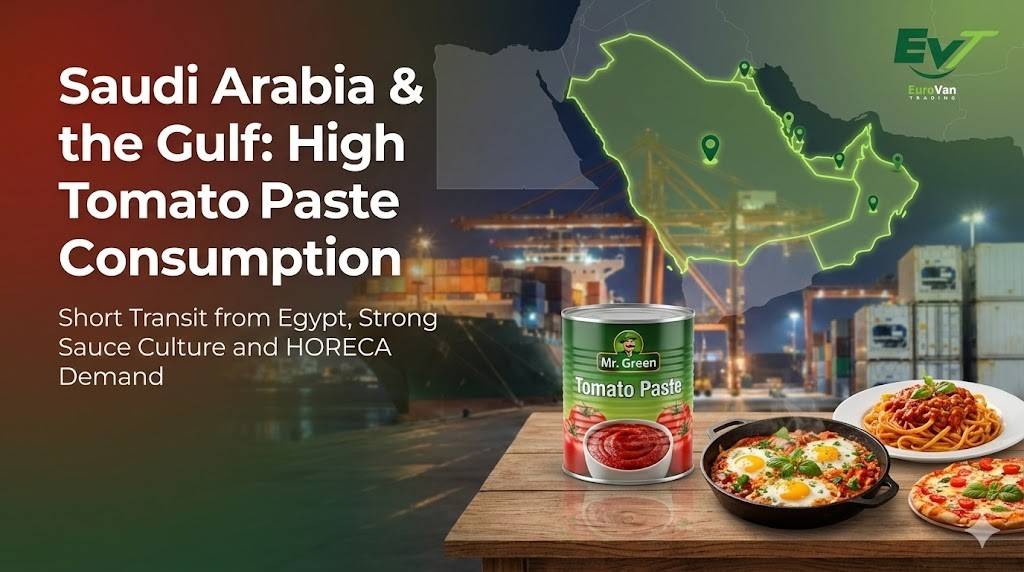
The Saudi market plays a very important role for tomato paste exporters close to the region. Consumers in Saudi Arabia and neighboring Gulf countries use tomato sauces and tomato paste in many daily dishes. Besides that, a strong HORECA and quick service restaurant (QSR) sector drives demand for pizza sauces, pasta sauces, and ketchup in large volumes.
Importers in Saudi Arabia usually look for:
- Industrial tomato paste 28–30° and 36–38° Brix for use as a base in their factories.
- Retail tins and pouches under local or international brands.
- Private label solutions for supermarket chains and wholesalers.
Because of the short distance between Egyptian ports and ports such as Jeddah and Dammam, Egyptian suppliers can offer attractive CIF Tomato Paste Price Per Ton with reasonable transit time. This combination makes Tomato Paste Price Per Ton for export to Saudi Arabia very interesting for both existing and new buyers.
Moreover, cultural and language proximity helps communication and negotiations. Many Saudi buyers feel more comfortable working with partners in Egypt than with distant suppliers.
5.3 Europe – High Standards and Strong Private Label Market
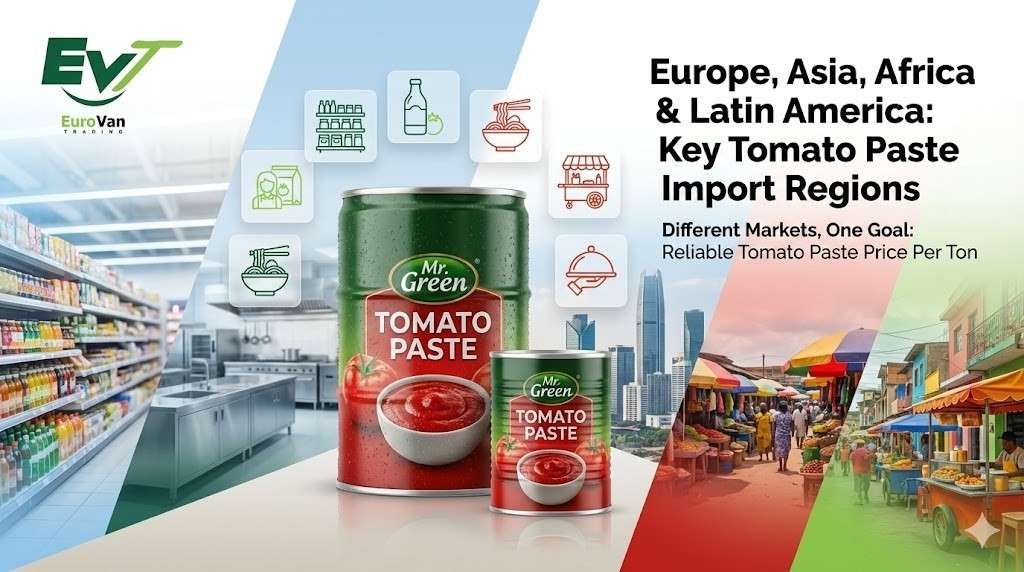
Europe remains one of the biggest and most demanding buyers of tomato-based products. Countries such as Germany, the United Kingdom, France, Italy, and the Netherlands import tomato paste both for:
- Retail brands that you see on supermarket shelves.
- Private label lines for large retail chains.
- Food industry use, including soups, ready meals, and sauces.
European buyers usually demand:
- Strong documentation and traceability.
- Compliance with EU food safety regulations.
- Stable color, flavor, and viscosity over many production batches.
Even when Europe has its own production, importers sometimes prefer to balance their supply by bringing in paste from non-EU origins, especially when they need competitive prices or when local crops face challenges. For these buyers, Egyptian tomato paste can become a flexible alternative, particularly for industrial 28–30° and 36–38° Brix grades.
When you target Europe, you must show a deeper understanding of specifications, microbiological limits, and packaging standards. Here, a professional export partner like Eurovan Trading adds real value by coordinating between Egyptian factories and European import expectations.
5.4 Asia – Quality-Focused Markets Like Japan
In Asia, demand splits between large-volume, price-driven imports and very strict, quality-driven markets. Japan, for example, is famous for its high expectations regarding safety, taste, and consistency. Manufacturers in Japan pay close attention to:
- Brix and viscosity consistency from batch to batch.
- Natural color with no off-tastes.
- Clean labels and detailed documentation.
Other Asian markets, such as parts of Southeast Asia, import tomato paste mainly for local sauce and noodle brands, as well as for food service. Some of these buyers prefer 36–38° Brix double concentrated paste, because it reduces shipping cost and offers good flexibility in recipes.
Egypt can serve these markets competitively when buyers look for a balance between quality and cost, especially if they want to diversify away from a single origin.
5.5 Africa & Latin America – Growing, Price-Sensitive Markets
In Africa, markets such as Ghana and Nigeria import tomato paste to support strong local consumption of tomato-based dishes. For many consumers in these regions, imported tomato paste in tins or sachets is a daily staple. Therefore, buyers in these markets place heavy emphasis on:
- Competitive Tomato Paste Price Per Ton Wholesale Worldwide offers.
- Consistent quality that prevents complaints at retail level.
- Flexible payment terms where possible.
In Latin America, including markets like Mexico, demand focuses on both industrial and retail products. Some buyers look for tomato paste to support their own sauce brands; others re-pack paste under local private labels.
Because freight distances vary, Egypt may not always be the first origin to consider for Latin America. Nevertheless, in some trade routes and in special situations, Tomato Paste EXPORT FROM EGYPT TO WORLDWIDE customers in these regions can still make sense, especially when they need specific Brix degrees or want a second source.
🇪🇬 6. Why Source Tomato Paste from Egypt?
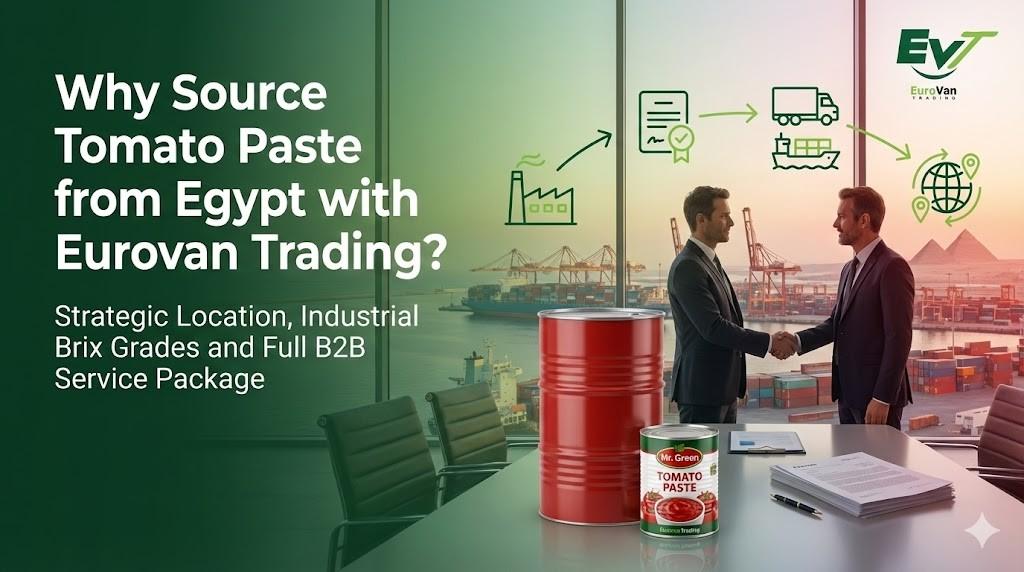
After reviewing demand in different regions, the next logical question is: Why do so many importers consider Egypt when they search for Tomato Paste Price Per Ton? The answer lies in a combination of geography, agricultural capacity, industrial know-how, and flexible export culture.
6.1 Strategic Geographic Position
Egypt sits at the crossroads of Africa, the Middle East, and Europe. Because of this location, transit times from major Egyptian ports to key markets remain very attractive:
- To Saudi Arabia and other GCC ports, vessels often need only a few days.
- To North African and Eastern Mediterranean destinations, transits are short and flexible.
- To Southern Europe, Egypt competes effectively with more distant suppliers.
Shorter distances often mean:
- Lower ocean freight per ton of paste.
- Fresher arrival and reduced risk during long sea journeys.
- Better flexibility for urgent orders and seasonal top-ups.
When buyers evaluate Tomato Paste Price Per Ton for export, they must always consider the combined effect of FOB price plus freight. Egypt often wins in this combined comparison, especially for Gulf and African destinations.
6.2 Strong Industrial Base in Brix Grades for Sauces
Egypt has a well-developed tomato processing industry. Many factories specialize in producing industrial tomato paste in 28–30° and 36–38° Brix, with both hot break and cold break options. This specialization matches perfectly with the needs of sauce and ketchup manufacturers in Saudi Arabia, Europe, Africa, and other regions.
Typical Egyptian industrial paste characteristics include:
- 28–30° Brix: ideal as a direct base for mass-market sauces and ketchup.
- 36–38° Brix: double concentrated paste, perfect for premium or space-efficient shipping.
- Availability in aseptic 220 L steel drums with food-grade inner bags.
- Shelf life commonly up to 24 months under proper storage.
Because factories run large campaigns during the tomato season, Egypt can support continuous, repeated shipments. This capacity allows importers to sign longer-term agreements and stabilize their Tomato Paste Price Per Ton over a period, instead of buying spot shipments only.
6.3 Quality, Certifications, and Compliance
In addition to cost and location, importers care about food safety and compliance. Many Egyptian tomato paste producers invest in:
- HACCP and ISO systems.
- International standards such as BRC or IFS (depending on the factory).
- Modern evaporation and aseptic filling equipment.
These investments allow them to serve not only local markets but also demanding export customers. When you work with a professional trading company such as Eurovan Trading, you gain access to factories that already ship to strict destinations. This reduces your risk and saves you time on audits and document negotiations.
Furthermore, Eurovan helps you align:
- Product specs (Brix, color, viscosity, acidity).
- Packaging requirements (drum type, palletization, labels).
- Documentation (health certificates, analysis, origin certificates).
As a result, your Tomato Paste EXPORT FROM EGYPT TO WORLDWIDE shipments run more smoothly, and you avoid costly delays at destination.
6.4 Eurovan Trading’s Position in the Egyptian Ecosystem
Eurovan Trading does not operate as a single factory. Instead, it acts as a specialized export partner that connects serious buyers with the right production sources in Egypt. This model creates several advantages for importers:
- Choice and flexibility: Eurovan can match your required Brix degree, packaging, and volume with a suitable factory or group of factories.
- Stronger negotiating power: By aggregating orders, Eurovan can often secure more competitive Tomato Paste Price Per Ton Wholesale Worldwide than a buyer can achieve alone.
- Professional communication: The Eurovan team speaks the language of international trade, understands Incoterms, and responds quickly to technical and commercial questions.
You can explore Eurovan’s broader portfolio on the Brands page and review specific product lines such as Eurofood products and Deja products. These brands confirm that Eurovan works daily with high-volume FMCG and food items, not only with raw materials.
In short, when you look for Tomato Paste Price Per Ton for export from Egypt to worldwide markets, Eurovan Trading offers not only a price, but also a complete service package.
🤝 7. Eurovan Trading: Your Tomato Paste Partner Wholesale Worldwide
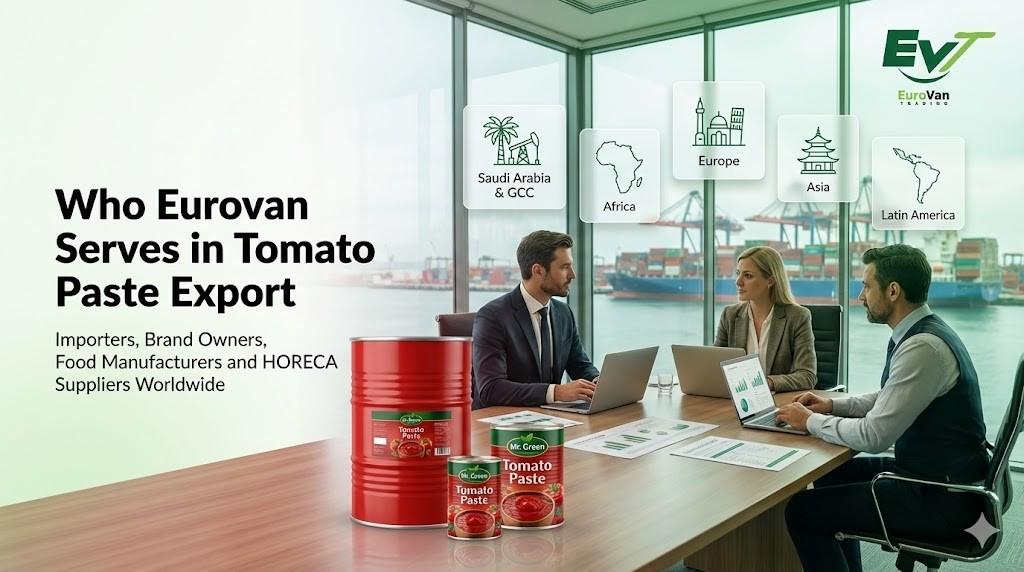
Once you understand markets, Brix degrees, and Egypt’s strengths, the final decision comes down to choosing a reliable partner. This is where Eurovan Trading positions itself clearly: as a B2B export specialist that supports you from first inquiry to final delivery.
7.1 Who Eurovan Serves
Eurovan focuses on professional buyers, not on retail consumers. Typical partners include:
- Importers and wholesalers who distribute tomato paste and sauces in their own markets.
- Brand owners and private label companies who need a consistent base for their ketchup, pasta sauce, or pizza sauce lines.
- Food manufacturers and HORECA suppliers who use tomato paste in industrial recipes or food-service packs.
These partners often operate in:
- Saudi Arabia and other GCC countries
- North and Sub-Saharan Africa
- European markets
- Selected Asian and Latin American destinations
By covering multiple regions, Eurovan gains a wide view of Tomato Paste Price Per Ton Wholesale Worldwide and understands how each market calculates value.
7.2 Product Scope and Brix Options
In tomato paste alone, Eurovan can typically arrange:
- Industrial grades: 28–30°, 30–32°, 32–34°, and 36–38° Brix
- Processing options: cold break (CB), hot break (HB), and super hot break (SHB) where available
- Packaging: aseptic 220 L drums, IBCs when required, and even retail-ready packs through associated brands
For sauce and ketchup producers, the most important grades remain 28–30° and 36–38° Brix, because they serve as efficient bases for:
- Standard ketchup and economy sauces.
- Thick, premium ketchup and pizza sauces.
- Multi-purpose tomato bases for ready meals and food-service applications.
Eurovan aligns each quotation with your exact needs and supports you in choosing the most suitable Brix for your recipes.
7.3 Service Package Beyond the Ton Price
Many suppliers can send you a number on email. Eurovan, however, focuses on building long-term value by offering more than just a Tomato Paste Price Per Ton:
- Specification matching: Eurovan reviews your technical sheet and makes sure the offered paste meets your standards for Brix, color, and microbiology.
- Sampling and approvals: When needed, Eurovan coordinates samples so that your lab and R&D team can test the paste in real applications.
- Documentation and compliance: The company prepares all necessary export and health documents and coordinates with authorities.
- Logistics support: Eurovan works with reliable forwarders to secure space and optimize shipment schedules.
This complete service means you can focus on your own business—marketing, distribution, and production—while Eurovan handles the technical and export side.
7.4 Clear Calls to Action
Whenever you feel ready to explore real numbers instead of theory, you can:
- Request a live quotation for Tomato Paste Price Per Ton for Export by visiting the Get a Quote page.
- Discuss cooperation, brand projects, or distribution roles through the Contact Us page.
- If you want to act as a long-term partner in your market, you can also check the Become a Distributor page and share your profile.
Eurovan’s team will then respond with the information, samples, and proposals you need.
📦 8. How to Calculate Your Landed Cost Per Ton (Importer’s Guide)
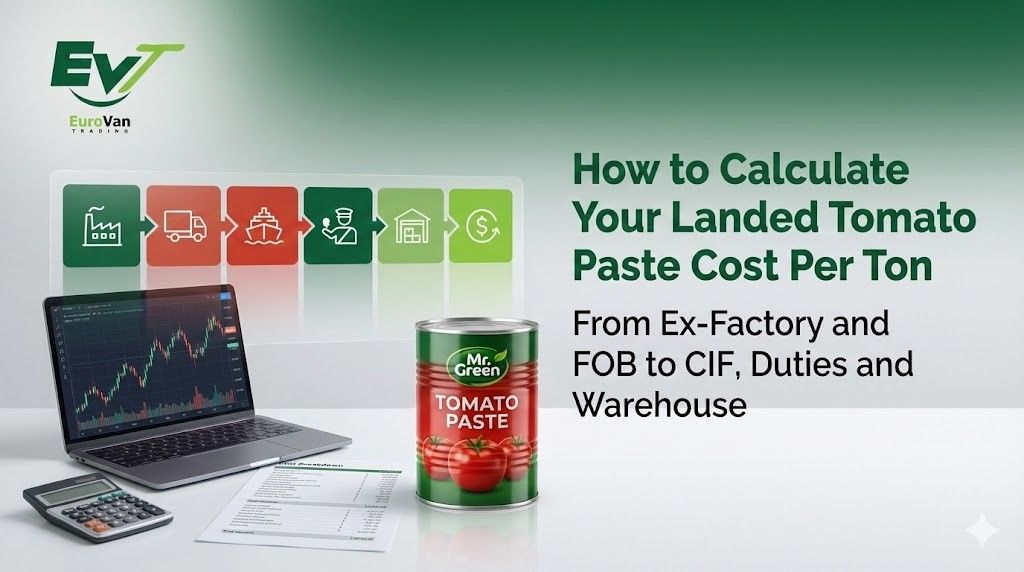
Even the best Tomato Paste Price Per Ton Wholesale Worldwide offers mean little if you do not translate them into landed cost. Landed cost is the amount you actually pay once the product reaches your warehouse, including transport, duties, and local charges. Smart importers always calculate this number before they sign any contract.
8.1 From Ex-Factory to Landed & Cleared
To see the full picture, follow the typical cost path:
- Ex-Factory / Ex-Works price – what the factory charges at its gate.
- Local transport & export handling – moving goods from factory to port and preparing them for export.
- FOB price – Ex-Works plus local handling up to loading on the vessel.
- Ocean freight & insurance – cost of shipping from origin port to your destination port.
- CFR / CIF price – FOB plus freight (and insurance in case of CIF).
- Import duties, taxes, and port charges – payments at your destination country.
- Internal transport – moving goods from port to your warehouse.
When you add all these elements, you obtain the landed and cleared cost per ton. Only then can you judge if an offer for Tomato Paste Price Per Ton is really competitive.
8.2 Key Cost Elements to Analyze
While every country has different duty structures and port costs, some elements always matter:
- Product price per ton (by Brix and packaging)
Higher Brix and more expensive packaging increase this part, but they may reduce freight per unit of solids and improve your yield. - Ocean freight
Freight from Egypt to Saudi Arabia or nearby ports usually remains lower than freight from very distant origins. This difference can change the final ranking of your offers. - Import duties and VAT
Some countries apply reduced tariffs or special trade agreements for certain origins. Always check if Egypt enjoys any preferential treatment in your market. - Local handling and distribution costs
These include port terminal charges, customs clearance fees, and warehousing. They may look small per ton but they add up in large programs.
When Eurovan prepares a quote, the team can help you separate the product price and the transport components, so you know exactly which part you are negotiating.
8.3 Simple Example: Comparing Two Scenarios
Imagine you are a sauce manufacturer in Saudi Arabia. You receive two hypothetical offers from Egypt (numbers are just for demonstration):
- Offer A:
- 28–30° Brix tomato paste in aseptic drums
- Lower FOB Tomato Paste Price Per Ton
- Offer B:
- 36–38° Brix tomato paste in aseptic drums
- Higher FOB Tomato Paste Price Per Ton
If you compare only the FOB prices, you will choose Offer A. However, if you:
- Calculate how much finished sauce you obtain from each ton,
- Add the same freight and duties,
- And divide your total cost by the final kilograms of sauce you produce,
…you may discover that Offer B gives you a better cost per kg of finished sauce, because it contains more tomato solids and requires less paste for the same recipe.
Therefore, the smartest way to evaluate Tomato Paste Price Per Ton is always to bring the calculation back to your own recipe and your own selling price. Eurovan Trading can assist with such calculations and help you choose the combination of Brix degree, packaging, and shipment size that maximizes your margin.
❓ 9. FAQ – Tomato Paste Price Per Ton & Export from Egypt
To close this guide, here are some common questions that importers ask when they first approach Eurovan about Tomato Paste Price Per Ton Wholesale Worldwide.
Q1: What is the typical Tomato Paste Price Per Ton for export from Egypt?
There is no single fixed price, because tomato paste behaves like a commodity. The price changes with the tomato season, energy costs, and freight rates. Moreover, it also changes depending on the Brix degree, packaging (aseptic drum or retail), and destination port.
Instead of publishing a static list, Eurovan Trading provides live quotations. When you share your target Brix (for example 28–30° or 36–38°), your required quantity, and your destination (such as Saudi Arabia, Europe, or Africa), the team calculates a real Tomato Paste Price Per Ton for export from Egypt that fits current conditions. You can request this easily through the Get a Quote page.
Q2: Which Brix level is best for ketchup and tomato sauces?
For ketchup and sauces, the most common industrial grades are 28–30° Brix and 36–38° Brix:
- 28–30° Brix works very well for standard ketchup, pasta sauce, and pizza sauce. It offers a strong balance between ease of use and cost.
- 36–38° Brix suits thicker, premium products and situations where you want to ship more tomato solids and less water.
Some buyers also use 30–32° or 32–34° Brix when they want specific viscosity or yield. The “best” Brix always depends on your recipe and market. Eurovan can analyze your requirements and recommend the most efficient Brix degree for your sauces.
Q3: Which countries import the most tomato paste worldwide?
Large import markets include several European countries such as Germany, the UK, France, and the Netherlands, as well as Japan and other Asian destinations. In addition, Saudi Arabia and other Gulf markets import significant volumes for both retail products and food-service needs.
Moreover, African countries like Ghana and Nigeria, and Latin American markets such as Mexico, also play an important role in global imports. All these buyers contribute to the continuous demand that shapes Tomato Paste Price Per Ton Wholesale Worldwide.
Q4: Why do importers choose Egypt as a tomato paste supplier?
Importers choose Egypt for several strategic reasons:
- Competitive production costs and a long tomato processing season.
- Short transit times to Saudi Arabia, the Gulf, Africa, and Southern Europe.
- Strong industrial focus on 28–30° and 36–38° Brix grades, ideal for sauces and ketchup.
- Access to factories that follow international food safety and quality standards.
When combined with the export experience of Eurovan Trading, Egypt becomes an efficient and reliable source for Tomato Paste EXPORT FROM EGYPT TO WORLDWIDE markets.
Q5: How can I get a real-time quotation for Tomato Paste Price Per Ton from Eurovan Trading?
To receive a real-time quotation, you only need to provide a few details:
- Required Brix degree (for example 28–30° or 36–38°).
- Packaging type (aseptic drums, IBCs, or other).
- Destination port and preferred Incoterm (FOB, CFR, CIF).
- Estimated volume and frequency (one shipment or long-term program).
You can share this information directly via the Get a Quote form. Eurovan will then reply with a tailored Tomato Paste Price Per Ton and all relevant technical details.
Q6: Can Eurovan Trading ship tomato paste to Saudi Arabia, Europe, Africa, and Latin America?
Yes. Eurovan Trading supports shipments to Saudi Arabia and other GCC countries, many African markets, and a range of European and Latin American destinations. The company works with trusted logistics partners and coordinates the complete export process, from factory to departure port and beyond.
If you want to open or expand your tomato paste business in any of these regions, you can contact Eurovan through the Contact Us page or share your distribution profile via the Become a Distributor page.
📞 Contact Eurovan Trading
If you are ready to discuss real numbers or explore cooperation on Tomato Paste Price Per Ton Wholesale Worldwide, you can reach Eurovan Trading using the details below:
You can also request detailed quotations directly Get a Quote
- 5 el-Sheikh kamel Khadr ST– el Safarat distract Nasr city, Cairo , Egypt
- +201208287576
- [email protected]
Tomato Paste Price Per Ton, tomato paste wholesale, Egypt tomato paste exporter, tomato paste Germany, tomato paste UK, tomato paste France, tomato paste Japan, tomato paste USA, tomato paste Mexico, tomato paste Ghana, Eurovan Trading