
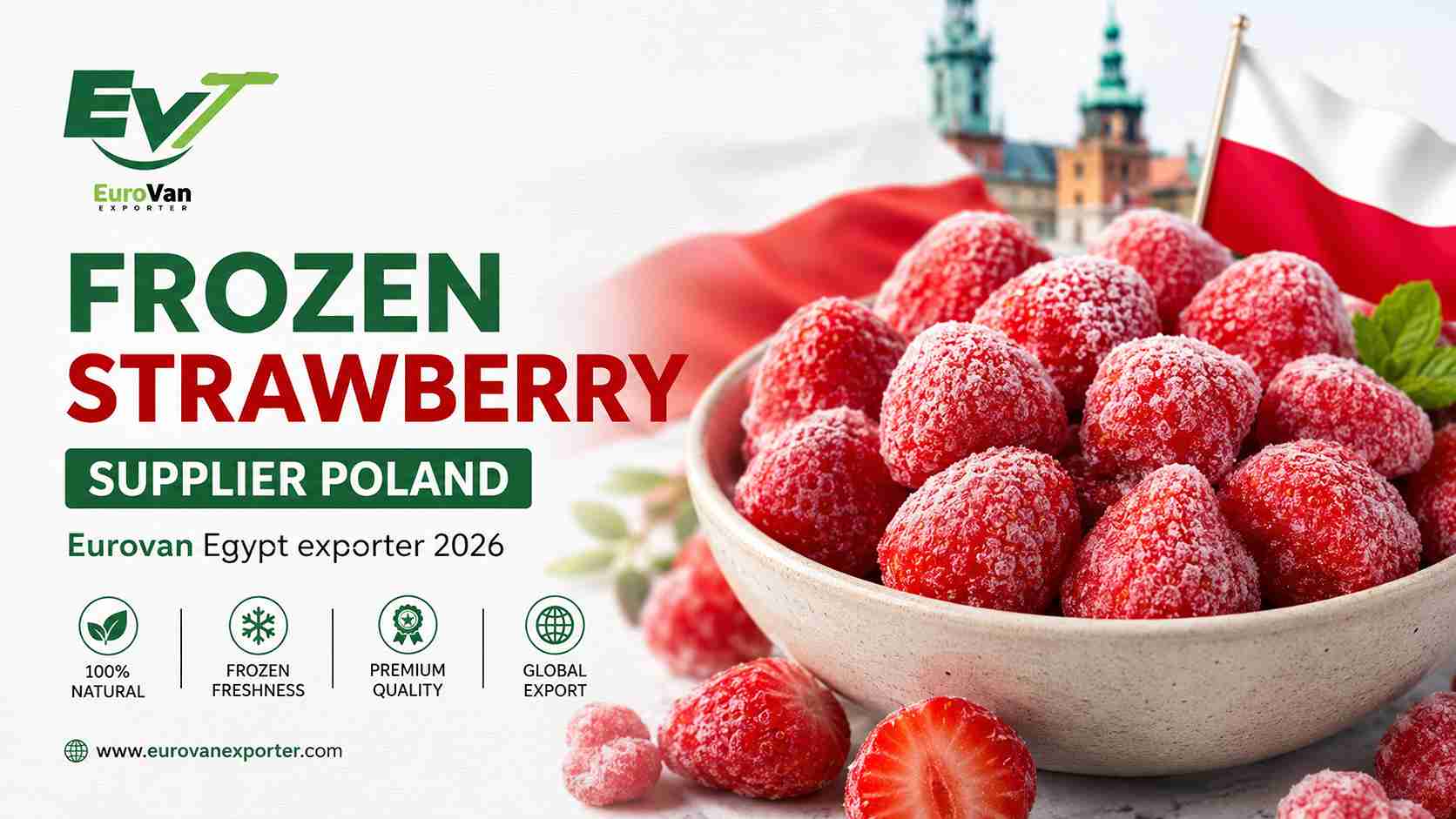
Frozen Strawberry Supplier Poland — IQF Export from Egypt
A Polish-buyer’s guide to sourcing IQF strawberries directly from Egyptian harvests, with EU-compliant documentation and uninterrupted cold-chain to Gdańsk.
Polish ice-cream factories, jam producers and yogurt manufacturers face a familiar problem each Q4: domestic strawberry stocks deplete, Spanish lots quote at premium, and the spring harvest is six months away. Eurovan closes that gap. We have shipped IQF whole, sliced and diced strawberries from Egyptian processing plants to EU consignees for over a decade, and Poland is one of our most active global frozen strawberry corridors.
What you receive is a single-origin reefer container — Festival, Fortuna or Sensation cultivars — held continuously at -18°C, fully traceable back to the farm block, and arriving Gdańsk or Gdynia in 35–45 days from PO confirmation.
№ 01 / VIII
Why Poland Sources Egyptian IQF Strawberries
Key Takeaways
- Egyptian harvest runs November–May, the exact window when Polish stocks run thin.
- Festival and Fortuna cultivars deliver the deep red, balanced-Brix profile Polish jam and yogurt makers specify.
- Sea freight Alexandria → Gdańsk averages 15–21 days versus 28–35 days from Latin American origins.
- EUR.1 movement certificates allow preferential duty entry under the Egypt-EU Association Agreement.
- Eurovan handles full documentation: phytosanitary, COA, COO, B/L, temperature data logger trace.
Polish frozen-fruit demand is structurally seasonal. Domestic strawberry harvest concludes in early July, processors freeze through August, and by late autumn most national cold stores have committed their Q1 stock to long-running supply contracts. The result, year after year, is a familiar squeeze for buyers between October and April. Spanish and Moroccan lots tighten, prices push up by 18–22%, and specifications for retail-grade Brix and colour become harder to honour. This is the gap that Egyptian IQF strawberries were built to close.
Eurovan’s growers across Beheira and Ismailia begin harvesting in November. By February — the leanest month for Polish stockists — Egyptian fields are at peak yield, with calibre-graded Festival and Fortuna available in commercial volumes. Sea freight to Gdańsk takes 15–21 days, materially shorter than Chilean or Argentinian alternatives, and the Egypt-EU Association Agreement permits competitive landed-cost pricing with EUR.1 preferential origin certificates.
A Polish jam producer doesn’t need cheap strawberries — they need consistent strawberries. That is what single-origin Egyptian IQF delivers, container after container.
What’s distinctive about supplying Poland specifically — versus, say, the GCC or North America — is documentation depth. Polish customs, working under EU Reg 2017/625, expects a complete phytosanitary chain that traces back to harvest block. Eurovan’s QA team is built around exactly that. Every container leaves Alexandria with a PIORIN-aligned phytosanitary certificate, an Egyptian Ministry of Agriculture health certificate, batch-level COAs, and a calibrated temperature data logger trace — the full pack a Polish customs agent needs to clear in 24–48 hours rather than wait three working days for additional papers.
For Polish buyers comparing us against larger Latin American or Chinese suppliers, the meaningful difference is responsiveness. We answer Polish-time emails on the same day, our cold-chain desk holds product specs for the major Polish processors on file, and we maintain a small consolidation point at Damietta for buyers who need mixed-frozen-product pallets rather than a single SKU container.
· · ·
№ 02 / VIII
Product Range & Cut Specifications
Each cut format is engineered for a specific Polish industrial application. Whole IQF strawberries — graded by diameter — are the format jam producers and premium yogurt brands prefer because the berry retains its visible identity through pasteurisation. Sliced berries, cut clean at 5–8 mm, are the standard for fruit-on-the-bottom yogurt and bakery toppings. Diced strawberries at 10 mm cubes flow through automated dosing lines without bridging, which makes them the workhorse format for smoothie concentrate and ice cream ribboning. Below is the specification matrix Polish buyers most often request from us, but every cell is adjustable on request and we’ll happily quote against a tighter Brix range or a custom calibre.
IQF Whole
Calibres 15–25 mm, 25–35 mm, 35 mm+. Festival cultivar default. Held to Grade A red, no white shoulders. Ideal for premium jam, dessert toppings, fruit confiture.
IQF Sliced
5–8 mm slice, calibrated through optical grader. Drip loss target <6%. Standard for fruit-on-bottom yogurt, bakery layering, fruit cocktails, retail mixed berry packs.
IQF Diced
10 mm cube, free-flowing. Engineered for automated dosing and ribbon machines. Standard for industrial smoothie, ice cream, sauce, and beverage compound work.
Brix & Acidity
Festival typical Brix 7.5–9.0°, Fortuna 8.0–9.5°, Sensation 7.0–8.5°. Titratable acidity 0.7–1.0%. Polish processors specifying jam standard get 8°+ default.
IQF Process
Tunnel freezer at -35°C core temperature, individually frozen within 90 seconds of de-stemming. No agglomeration, free-flowing through Polish dosing equipment.
QA & Microbiology
Total bacterial count <10⁵ cfu/g, yeast & mould <10⁴, Listeria absent in 25 g, Salmonella absent in 25 g. Each batch tested in accredited lab pre-shipment.
Specification is a contract. If it’s on the COA, it ships. If it isn’t on the COA, we don’t claim it — and that posture has held our Polish renewal rate above 80%.
For Polish buyers needing technical data sheets in advance of LC opening, our cold-chain desk can issue a full spec pack within four hours during business days. We also support third-country routings for Polish parent companies serving North American subsidiaries from a single Egyptian origin contract.
№ 03 / VIII
EU & Polish Import Compliance
Compliance is where most Polish-import problems for frozen fruit actually originate, not at the farm gate. We’ve watched containers from less-experienced exporters sit at Gdańsk for ten working days because a phytosanitary certificate listed an old HS code, or a COA arrived without a notarised translation. Our process is built to prevent that. Below are the six requirement layers each shipment passes through before the container is even sealed at Alexandria.
Pesticide Residue Compliance — EU Reg. 396/2005
Each batch is tested against the EU Maximum Residue Levels for strawberries before lot release. Common parameters monitored include captan, chlorothalonil, lambda-cyhalothrin and fluopyram. Test certificates issued by ISO 17025-accredited labs accompany the consignment.
Microbiological Criteria — EU Reg. 2073/2005
For ready-to-eat frozen fruit destined for Polish HoReCa, additional testing for Listeria monocytogenes, E. coli STEC, and Salmonella spp. is performed at sub-lot level. Method: ISO 11290-1, ISO 16649-2, ISO 6579-1.
Phytosanitary Certificate — PIORIN-Aligned
Each container ships with an Egyptian phytosanitary certificate format the Polish State Plant Health and Seed Inspection Service (PIORIN) recognises, declaring the consignment free of regulated pests and pathogens.
Health Certificate — Egyptian Ministry of Agriculture
Issued by the Central Administration of Plant Quarantine, this document confirms processing under approved facilities, cold-chain integrity, and product fitness for human consumption — required for EU border control post.
Certificate of Origin & EUR.1
Egyptian COO issued by the Federation of Egyptian Industries plus EUR.1 movement certificate under the Egypt-EU Association Agreement. EUR.1 enables preferential duty treatment at Polish customs, materially lowering landed cost.
Facility & Process Certifications
Source facilities operate under ISO 22000:2018 food safety management and HACCP. BRCGS-aligned hygiene controls. SCAL Egypt certification on file. EU food business operator (FBO) registration provided to the Polish consignee on request.
Polish customs brokers we work with regularly clear our shipments at Gdańsk in 24–48 hours — well inside the EU 5-working-day legal limit — because the documentation pack maps directly onto the TARIC code for HS 0811.10 (strawberries, frozen, with or without added sugar). For verification, you can cross-reference the Egyptian export framework on the official Egyptian Customs Authority portal.
№ 04 / VIII
Technical & Packaging Specifications
Below are the two tables a Polish quality-control manager will want before signing PO. Specifications are typical for our standard Festival cultivar; tighter or looser tolerances available on request.
| Product Name | IQF Frozen Strawberry |
|---|---|
| HS Code | 0811.10 |
| Variety | Festival / Fortuna / Sensation |
| Cuts Available | Whole, Sliced (5–8 mm), Diced (10 mm) |
| Calibre (Whole) | 15–25, 25–35, 35 mm+ |
| Brix Level | 7.5–9.5° |
| Titratable Acidity | 0.7–1.0% |
| Color (Pantone Ref.) | Grade A — uniform red |
| Drip Loss | <6% upon thaw |
| Total Bacterial Count | <10⁵ cfu/g |
| Yeast & Mould | <10⁴ cfu/g |
| Listeria / Salmonella | Absent in 25 g |
| Inner Bag | HDPE food-grade liner |
|---|---|
| Outer Carton | 5-ply corrugated |
| Net Weight per Carton | 10 kg |
| Gross Weight per Carton | 10.5 kg |
| Carton Dimensions | 40 × 30 × 14 cm |
| Cartons per Pallet | 100 (10 layers × 10) |
| Pallet Type | EUR / EPAL heat-treated |
| Pallet Net Weight | 1,000 kg |
| Pallets per 40′ Reefer | 26 |
| Net per 40′ Reefer | ~26,000 kg |
| Storage Temperature | -18°C constant |
| Shelf Life | 24 months at -18°C |
For private-label retail packs from 250 g to 1 kg with full Polish-language compliance labelling, our artwork desk delivers proofs within 72 hours.
Private-label runs are quoted separately and use the same upstream IQF stock — only the downstream pack format changes. For multi-SKU orders combining strawberries with other frozen lines, you can also explore our bulk frozen vegetables from Egypt programme, since both share the same reefer routing and documentation desk.
№ 05 / VIII
Egypt → Poland Cold-Chain Timeline
A frozen strawberry shipment is not a one-step transaction; it’s a five-step temperature-controlled journey that starts in an Egyptian field and ends on a Polish receiving dock at -18°C. Below is the standard timeline our Polish customers see, mapped against working days. The window can compress to as fast as 28 days for repeat customers with stock allocation, or stretch to 50 days for first-time accounts that need full sample approval and LC instrument review.
PO Confirmation & Deposit
Polish buyer confirms purchase order, signs proforma, and remits 30% T/T deposit. Our cold-chain desk allocates production capacity and books the reefer slot with the carrier.
Same-Day ConfirmationProduction & QC Lab Testing
Berries are harvested at peak ripeness, cleaned, de-stemmed, calibrated through optical sorters, IQF-tunnelled at -35°C, packed in HDPE liners and 10 kg cartons, palletised, and held at -25°C blast-store. Lab issues batch COA.
10 Working DaysReefer Loading at Alexandria
Pre-cooled 40′ reefer container delivered; loading under continuous temperature monitoring; USB temperature data logger placed inside container; container sealed; documentation pack despatched to consignee in parallel.
2 Working DaysSea Freight Alexandria → Gdańsk
Standard transit 15–21 days depending on schedule. Reefer power monitored at every transhipment. Polish consignee receives B/L scan within 5 working days of vessel sailing.
15–21 Days Sea TransitPolish Customs & DAP Delivery
Polish customs broker submits SAD; with full pre-arrival documentation, clearance typically takes 24–48 hours. Refrigerated road haulage onward to Poznań, Warsaw, Łódź or Wrocław as required, all under -18°C continuous.
2–4 Days Final MileFor buyers comparing Egyptian routing against the Mediterranean alternatives, our frozen strawberry supplier from Egypt overview sets out the carrier rotations, transhipment hubs, and standard freight cost ranges. It’s a useful primer if you’re benchmarking landed cost against Spanish or Moroccan suppliers.
№ 06 / VIII
Polish Buyers We Serve
We’ve shipped IQF strawberries to Polish counterparties across eight industrial categories. Each segment has slightly different specification priorities — and our team is set up to talk fluently to each.
Yogurt Manufacturers
Fruit-on-bottom and stirred yogurt lines — sliced and diced formats.
Jam & Preserves
Whole IQF for premium jam and confiture; high-Brix specifications.
Ice Cream Factories
Diced format for ribboning machines; consistent calibre, low drip.
Bakery & Confectionery
Sliced format for tart toppings, layer cakes, viennoiserie fillings.
Smoothie Bars & Cafés
Whole and diced packs for HoReCa quick-serve and barista programmes.
Hotels & HoReCa Groups
Buffet-grade whole IQF for breakfast service; portion-control diced.
Private Label Retailers
250 g–1 kg retail packs with Polish labelling and EAN/GS1 barcodes.
Frozen Re-Distributors
Wholesale buyers re-supplying mid-tier processors across Central Europe.
If your Polish operation runs across more than one frozen category, our consolidated frozen vegetables supplier programme and frozen mixed vegetables lines load on the same reefer corridor as the strawberry programme — useful for procurement teams looking to minimise the number of supplier audits.
№ 07 / VIII
Why Eurovan for Your Polish Supply
Anyone can ship a container. The question Polish buyers ask us in second-meeting due diligence is sharper: what happens when something goes wrong? A reefer trips power. A COA flag comes back at the lab. A vessel reroutes. The six points below are where we believe Eurovan earns its renewal rate, not where we win first orders.
12+ Years of Cold-Chain Export
Active Polish corridor since 2018. We know every customs broker at Gdańsk and Gdynia by name, and they know our documentation format.
EU-Aligned QA Discipline
Our QA manager spent four years inside an EU-buyer audit team. She runs our pre-export inspection by the same checklist a Polish customer would.
Direct-from-Farm Sourcing
We contract with growers in Beheira and Ismailia directly — no broker middle layer — which is how we hold price and traceability simultaneously.
Cold-Chain Integrity
USB data logger inside every container, full trace handed to the Polish consignee. Independent third-party verification on request, no charge.
Documentation Desk
Dedicated coordinator handles your phytosanitary, COA, COO and EUR.1 files. First-cut documents in your inbox within 24 hours of vessel sailing.
Polish-Language Coordination
We work with a Warsaw-based liaison for translated artwork, label compliance, and Polish-customs broker communication when speed matters.
Want to verify any of this against existing references? Read our about page, browse the full product catalogue, or — for the fastest answer — submit a request through our quote desk and a Polish-corridor specialist will respond inside one business day.
№ 08 / VIII
Frequently Asked Questions
The questions below are the ones Polish buyers actually ask in first-meeting due diligence — answered as our cold-chain desk would answer them in writing.
Question not covered above? Read our broader company FAQ, or send specifics to the cold-chain desk and a Polish-corridor specialist will write back inside one business day.
تصدير الفراولة المجمدة من مصر إلى بولندا مورد فراولة IQF معتمد · 12+ سنة خبرة في الشحن المبرد
تعمل يوروفان كمورد متخصص في تصدير الفراولة المجمدة IQF من المزارع المصرية في البحيرة والإسماعيلية إلى الموانئ البولندية في جدانسك وجدينيا. نوفر للعملاء البولنديين — مصانع الزبادي، ومصانع المربى، ومنتجي الآيس كريم، وشركات المخبوزات والحلويات — فراولة كاملة ومقطعة شرائح ومكعبات وفقًا لمواصفات الاتحاد الأوروبي الكاملة.
كل حاوية مبردة تخرج من ميناء الإسكندرية تحمل شهادة الصحة النباتية، وشهادة المنشأ، وشهادة EUR.1 للمعاملة التفضيلية الجمركية تحت اتفاقية الشراكة المصرية الأوروبية، بالإضافة إلى مسجل درجة حرارة موثق طوال رحلة الشحن البحري التي تستغرق 15–21 يومًا. نضمن استمرارية سلسلة التبريد عند -18°م حتى لحظة التسليم في المستودع البولندي.
اطلب عرض سعر للسوق البولنديDirect Line · Cold-Chain Desk
Request a Quote for the Polish Lane
Tell us your specification, container target, and Polish receiving port. A corridor specialist will respond inside one business day with a binding quotation, lead time, and the full documentation pack you’ll receive.
- Binding quote within 24 working hours
- Festival, Fortuna or Sensation cultivars on offer
- Whole, sliced or diced cuts
- Gdańsk, Gdynia or inland DAP options
- Polish-language artwork support for private label
- Full EU-import documentation included